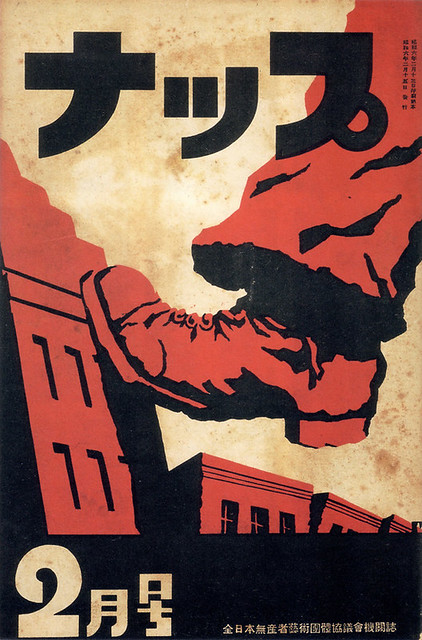
 NAPF (Japanese Proletarian Artists Federation) magazine cover, Feb 1931
Showing posts with label japan. Show all posts
Showing posts with label japan. Show all posts
Wednesday, November 23, 2011

Friday, July 22, 2011
Monday, July 11, 2011
Friday, March 4, 2011

Monday, February 14, 2011

Sunday, December 5, 2010

Thursday, October 21, 2010
Japanese Futurism
 "Defense for the country, tobacco for the society"
South Kyoto Tobacco Sellers' Union,
1937
via Pink Tentacle
Sunday, October 10, 2010


Friday, September 24, 2010

Tuesday, September 7, 2010
Fantasy Fighter
 Twin-boom pusher against Northrop Flying Wing
Actually, this fantasy is not too far from reality - Swedish SAAB 21 had the same configuration.
The pusher is Mansyu Ki-98 attacker (never built).
Image © Ronnie Olsthoorn, Ian Allan Publishing
Tuesday, August 10, 2010
Mavis
The Kawanishi H6K was an Imperial Japanese Navy flying boat used during World War II for maritime patrol duties. The Navy designation was "Type 97 Large Flying Boat".
 The aircraft was designed in response to a Navy requirement of 1934 for a long range flying boat and incorporated knowledge gleaned by a Kawanishi team that had visited the Short Brothers factory in the UK, at that time one of the world's leading producers of flying boats, and from building the Kawanishi H3K, a license-built, enlarged version of the Short Rangoon. The Type S, as Kawanishi called it, was a large, four-engine monoplane with twin tails, and a hull suspended beneath the parasol wing by a network of struts. Three prototypes were constructed, each one making gradual refinements to the machine's handling both in the water and in the air, and finally fitting more powerful engines. The first of these flew on 14 July 1936. Eventually, 217 would be built.
 The first major production version, the H6K4 was powered by four Mitsubishsi Kinsei 43 radiais and armed with four 7.7mm machine-guns in bow and midships positions and a 20mm cannon in a tail turret, and was capable of carrying two 800kg bombs or torpedoes, a total of 66 being in service at the time of Pearl Harbor; later aircraft were powered by Kinsei 46 engines. These boats were widely employed, although the initial heavy defeats inflicted on the Allies in the Pacific rendered maritime reconnaissance duties subordinate to the need for air transportation of Japanese troops during the swift conquests in the East Indies and elsewhere.
 A number of aircraft, designated H6K4-L, were converted for transport duties and were each able to accommodate about 18 fully-armed troops; lacking armour and self-sealing fuel tanks, however, they were extremely vulnerable to fighter attacks and, after a number had been shot down, a new version entered production as the H6K5 in August 1942; by that time the maritime reconnaissance version had been given the reporting codename 'Mavis' by the Allies, the transport derivative being named 'Tillie'.
 Powered by either Kinsei 51 or 53 radials, the H6K5 was intended to eliminate the shortcomings of the earlier versions, but although the open bow gun position was replaced by a single-gun turret immediately aft of the pilot's cockpit, the overall armament was not increased. Only 36 H6K5s were completed by 1943, when production gave place to the greatly superior H8K.
H6Ks served with the 8th, 14th, 801st, Toko and Yokohama Kokutais, and some of the H6K5s were employed as naval staff transports throughout the Pacific in 1943. Eighteen aircraft served on the quasicommercial courier services in South East Asia, a number of them being destroyed by Allied aircraft both in the air and at their moorings.
 The aircraft was designed in response to a Navy requirement of 1934 for a long range flying boat and incorporated knowledge gleaned by a Kawanishi team that had visited the Short Brothers factory in the UK, at that time one of the world's leading producers of flying boats, and from building the Kawanishi H3K, a license-built, enlarged version of the Short Rangoon. The Type S, as Kawanishi called it, was a large, four-engine monoplane with twin tails, and a hull suspended beneath the parasol wing by a network of struts. Three prototypes were constructed, each one making gradual refinements to the machine's handling both in the water and in the air, and finally fitting more powerful engines. The first of these flew on 14 July 1936. Eventually, 217 would be built.
 The first major production version, the H6K4 was powered by four Mitsubishsi Kinsei 43 radiais and armed with four 7.7mm machine-guns in bow and midships positions and a 20mm cannon in a tail turret, and was capable of carrying two 800kg bombs or torpedoes, a total of 66 being in service at the time of Pearl Harbor; later aircraft were powered by Kinsei 46 engines. These boats were widely employed, although the initial heavy defeats inflicted on the Allies in the Pacific rendered maritime reconnaissance duties subordinate to the need for air transportation of Japanese troops during the swift conquests in the East Indies and elsewhere.
 A number of aircraft, designated H6K4-L, were converted for transport duties and were each able to accommodate about 18 fully-armed troops; lacking armour and self-sealing fuel tanks, however, they were extremely vulnerable to fighter attacks and, after a number had been shot down, a new version entered production as the H6K5 in August 1942; by that time the maritime reconnaissance version had been given the reporting codename 'Mavis' by the Allies, the transport derivative being named 'Tillie'.
 Powered by either Kinsei 51 or 53 radials, the H6K5 was intended to eliminate the shortcomings of the earlier versions, but although the open bow gun position was replaced by a single-gun turret immediately aft of the pilot's cockpit, the overall armament was not increased. Only 36 H6K5s were completed by 1943, when production gave place to the greatly superior H8K.
H6Ks served with the 8th, 14th, 801st, Toko and Yokohama Kokutais, and some of the H6K5s were employed as naval staff transports throughout the Pacific in 1943. Eighteen aircraft served on the quasicommercial courier services in South East Asia, a number of them being destroyed by Allied aircraft both in the air and at their moorings.
Monday, July 5, 2010
Japanese cruiser Yūbari
Yūbari was a single light cruiser built between 1922 and 1923 for the Imperial Japanese Navy. She fought in World War II and was sunk by the US navy.
 This ship represents the beginning of all 'modern' Japanese cruiser design. She was originally laid down as an experimental cruiser under the guidance of Yuzuru Hiraga, the most famous Japanese naval architect of his time. Yubari presented quite a radical appearance with her combined, swept-back main funnel and clipper bow. She served as a prototype for the forthcoming Furutaka, which incorporated many of Hiraga's ideas concerning weight reduction and cramming the maximum firepower into a given displacement.
 The ship was completed 419 t (412 long tons) (13%) over the designed displacement, this resulted in an extra foot of draft and a loss of 1.5 kn (2.8 km/h; 1.7 mph) in designed speed. The ship was considered successful, however, and many of its features were used in subsequent Japanese warships.
 The ship had a significant refit in early 1944 when the two single 140 mm (5.5 in) guns were removed, one 120 mm (4.7 in) AA gun (in the "A" position) and six twin and one triple 25 mm (0.98 in) AA guns were added together with a search radar and depth charges.
Yubari served in the Pacific during World War II where she was the flagship of the Japanese invasion force during the invasion of Wake Island. She led both invasion attempts on 11 and 23 December 1941 and was damaged by US Marine coastal guns during the first attempted landing. Yubari was sunk on 27 April 1944 off Palau by the US submarine Bluegill.
 This ship represents the beginning of all 'modern' Japanese cruiser design. She was originally laid down as an experimental cruiser under the guidance of Yuzuru Hiraga, the most famous Japanese naval architect of his time. Yubari presented quite a radical appearance with her combined, swept-back main funnel and clipper bow. She served as a prototype for the forthcoming Furutaka, which incorporated many of Hiraga's ideas concerning weight reduction and cramming the maximum firepower into a given displacement.
 The ship was completed 419 t (412 long tons) (13%) over the designed displacement, this resulted in an extra foot of draft and a loss of 1.5 kn (2.8 km/h; 1.7 mph) in designed speed. The ship was considered successful, however, and many of its features were used in subsequent Japanese warships.
 The ship had a significant refit in early 1944 when the two single 140 mm (5.5 in) guns were removed, one 120 mm (4.7 in) AA gun (in the "A" position) and six twin and one triple 25 mm (0.98 in) AA guns were added together with a search radar and depth charges.
Yubari served in the Pacific during World War II where she was the flagship of the Japanese invasion force during the invasion of Wake Island. She led both invasion attempts on 11 and 23 December 1941 and was damaged by US Marine coastal guns during the first attempted landing. Yubari was sunk on 27 April 1944 off Palau by the US submarine Bluegill.
Sources: Wiki (EN), Furashita's Fleet
Monday, May 31, 2010
Japanese Autogyro
 Kayaba Ka.1 was powered by a 240hp Kobe engine (licence version of the German Argus As.10C); the first Ka.1 was flown on 26 May 1941 and eventually some 240 aircraft of this type were built. They were employed during World War 2 by the Imperial Japanese Army for artillery observation and cooperation duties, and by the Navy for coastal or carrier-based antisubmarine patrol carrying two 60kg bombs or depth charges. One Ka.1 was modified for trials with small auxiliary rockets at the tips of the rotor blades.
Source: Aviastar
Saturday, March 6, 2010
Human Dragonfly
 See & Air Exhibition, Tokyo
1930
See more Japanese posters @ pinktentacle's blog
or in Tome's gallery @ Dieselpunks.org
Monday, February 22, 2010
Armored Engineering Vehicle
 Soukou Sagyou Ki was Japan's first Engineering vehicle. Developed in 1935, it was based on the Type 89 Medium Tank. The vehicle was designed to perform the following tasks:
- Blasting tochca (pillbox) with 300kg demolition
- Excavating trench
- Disinfecting gas attack
- Flame throwing
- Breaking through obstacle
- Scattering poison gas
- Removing mines with mine plow
- Throwing up smoke screen
- Crane
- Bridge layer
 The "Manchurian Incident" showed that the vehicle was too small to perform all these tasks perfectly. The vehicle was redesigned and the tasks required of it were decreased. The last type was called the "SS SS-Ki Bo Gata" and could only do tasks 1, 4, 7, and 10 listed above. When Pacific War with the U.S. began, SS-Ki was sent to south front, as a bridge layer. In the battle of Philippines, 1945, the US captured 8 SS-Ki, without bridges. So US forces mistakenly classified SS-Ki as flame throwing tank. SS-Ki's detailed military service is unknown. 119 Produced (total of all types, Kou, Otsu, Hei, Tei, Bo).
Saturday, February 20, 2010

Saturday, February 13, 2010
Chinese Cruisers
The Ning Hai class were a pair of light cruisers in the Chinese fleet before World War II. Ning Hai ("Peaceful Seas"), the lead ship of the class, was laid down in Japan while the follow-on, Ping Hai ("Amicable Seas"), was laid down in China and completed with Japanese assistance to a slightly modified design that included the deletion of seaplane facilities (Ning Hai has a small hanger for two seaplanes).
 While Ning Hai was quickly commissioned, tensions between China and Japan plagued the efforts to complete the Ping Hai. Both served as flagships of the Republic of China Navy, with Ping Hai taking over the role from its older sister ship since April 1937. The ROCN had an ambitious plan to procure a larger and more-powerful command cruiser and then to re-assign the two vessels as scouts/flagships of submarine flotillas, but the outbreak of war with Japan put an end to all related efforts (including the acquisition of submarines).
 Ning Hai and Ping Hai were sunk in defense of the Kiangyin Fortress, Yangtze River, near Nanking by Japanese aircraft (of which the two ships shot down four) on September 23, 1937, but then re-floated by the Japanese. Originally they were to be transferred to the puppet government of Wang Jing-Wei, but the Japanese then had a change of heart and outfitted them first as barracks hulks and ultimately as 2nd class light cruisers Ioshima (Ning Hai) and Yasoshima (Ping Hai) in 1944.
 While Ning Hai was quickly commissioned, tensions between China and Japan plagued the efforts to complete the Ping Hai. Both served as flagships of the Republic of China Navy, with Ping Hai taking over the role from its older sister ship since April 1937. The ROCN had an ambitious plan to procure a larger and more-powerful command cruiser and then to re-assign the two vessels as scouts/flagships of submarine flotillas, but the outbreak of war with Japan put an end to all related efforts (including the acquisition of submarines).
 Ning Hai and Ping Hai were sunk in defense of the Kiangyin Fortress, Yangtze River, near Nanking by Japanese aircraft (of which the two ships shot down four) on September 23, 1937, but then re-floated by the Japanese. Originally they were to be transferred to the puppet government of Wang Jing-Wei, but the Japanese then had a change of heart and outfitted them first as barracks hulks and ultimately as 2nd class light cruisers Ioshima (Ning Hai) and Yasoshima (Ping Hai) in 1944.
Saturday, January 23, 2010
Divine Wind
 A Mitsubishi Ki-15 prototype,
called Kamikaze-go (Divine Wind), became famous as the first Japanese aircraft to fly from Japan to Europe.
The Tokyo - London flight, sponsored by the Asahi Simbun newspaper, started on April 6, 1937. In April 12 the plane landed at London's Croydon airport. The total elapsed time since departure was 94 hours, 17 minutes and 56 seconds, with actual flight time for the whole distance of 15,357 km of was 51 hours, 19 minutes and 23 seconds.
Thanks to pinktentacle we can enjoy the greeting cards printed in Japan to honor the historic flight.
Cards
Aircraft info (Wiki, EN)
Aircraft info (Wiki, EN)
Saturday, January 9, 2010

Saturday, August 29, 2009
Close, but no Leica
 Hansa Canon. c. 1937
The original model of Canon was the production version of the Kwanon, named for a Buddhist deity. It was originally a response to a call from the Emperor of Japan to the Japanese people to develop domestic technology and industry. The company that produced it, Seiki Kogaku (Precision Optical), was a new company that had never designed or marketed anything, much less a precision 35mm rangefinder camera. It was not a copy of the Leica, but rather a response to it. Great effort was made to avoid infringing upon patents by Leitz and Zeiss. Stumped by the German patents on rangefinder design, and lacking resources to develop their own optics, they turned to another Japanese company, Nippon Kogaku (Japan Optical), to help them out. Nippon Kogaku provided Seiki Kogaku with the rangefinder and focus mount design, as well as building the rangefinders and providing the lenses.
Text & photo © Pacificrimcamera
Text & photo © Pacificrimcamera
Subscribe to:
Posts (Atom)

 Posts
Posts

