Showing posts with label camera. Show all posts

Friday, September 21, 2012

Folder

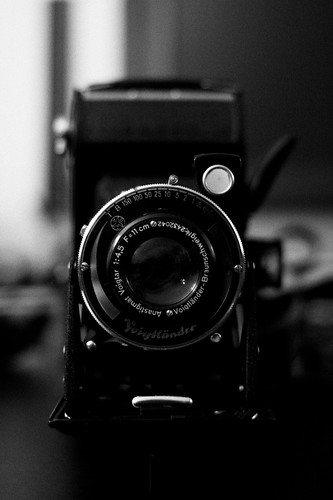
Voigtländer Bessa

This gorgeous German 6x9 folding camera is from the late 1930s or early 1940s, and isn't even a rangefinder: you get to measure the distance to your subject (though thankfully there's a handy DoF table on the back).
Winding is also fully manual, meaning you have to judge when you've wound the film far enough for a new frame, while not overlapping the previous exposure.
It does, however, give you the option to shoot 6x4.5 instead of 6x9, complete with a flip-up mask in the viewfinder. Brilliantly designed, especially for its age.

Text and photo: by Dan Rubin @ Flickr

Friday, August 3, 2012

Ensign Selfix

The Ensign Selfix 420 was a folding camera sold by Ensign from 1946. It was fitted with an Ensar Anastigmat lens and took 120 film with the ability to expose either eight 6×9 or twelve 6×6 frames with the optional application of a mask. It is very similar to the Selfix 20 which it succeeded.
The Selfix 420 is not a rare camera but it is much less common than many better known folders.

Source: Camerapedia. Photo by Ordinal

Friday, June 15, 2012

Far From Being Typical

The Beika and Beira are 35mm folding cameras made by Beier in the 1930s. On all the models, the square front standard is mounted on scissor struts, and there is a focusing lever, moving the lens and shutter unit as a whole. The camera was released in 1931 as the Beika. It has a folding optical viewfinder, and takes 3×4cm exposures on unperforated film, loaded in special cassettes. (When loaded with perforated film, the usable exposure format is about 24×40mm.)
The name was changed to Beira in 1932. The reason for that change is not known for sure, but maybe "Beika" sounded too close to "Leica". The camera was sold by Birnbaum as the Birelle.
In 1935, a coupled-rangefinder version was offered, incorporating the Okula prismatic rangefinder made by Ernst Krauss in Jena. With that equipment, the camera was called Beira Okula or Beira II.

Beira II photos: rebollo_fr @ Flickr
Text: Camerapedia

Sunday, June 3, 2012

For Professionals Only

Russ Gerow demonstrates the Fairchild K-4 aerial camera mounted for oblique photography in the middle crew station of Continental Air Map’s Douglas M-4. With a 1924 military sticker price of $2,628.62, the 46-lb. K-3 was the first camera to solve the vexing inter-lens shutter and film-spacing-system problems that plagued earlier aerial cameras. Offering selectable shutter speeds of 1/50th, 1/100th and 1/150th/sec, its standard 7” x 9-1/8” film yielded 115 exposures per 75-foot roll of film. Introduced in 1925, the $3,516 K-4 camera was basically a K-3 with an 8-inch lens cone and a heftier price tag. Photo taken at Long Beach, c. 1930-31, photographer unknown.

Sunday, April 15, 2012

Eight Years Before the Leica

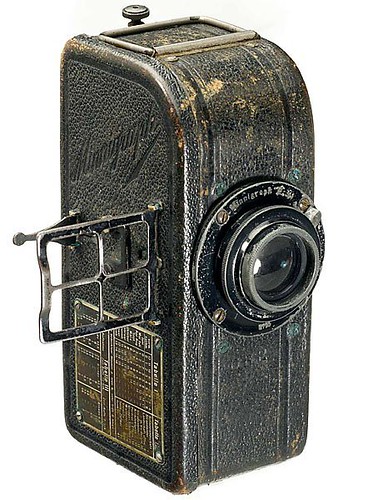
Levy Roth Minnigraph (1915) - first European serial-produced 35mm camera, taking fifty 18x24mm exposures using a special cassette.
Introduced eight years before the famous Leitz camera, the Minnigraph was still produced by Levy Roth, Berlin as late as in 1928.

See "Before It All Began" @ Dieselpunk Encyclopedia

Saturday, April 7, 2012

Just For Kids

Liliput - a small 36mm point-and-shoot camera produced in 1937-1939 at the State Optical & Mechanical Plant, Leningrad.
It had a bakelite body, fixed-focused f9/38mm lens, behind-the-lens leaf shutter and Albada viewfinder. Instead of regular film rolls or cassettes, the Liliput used special cartridges for eight or twelve 24x24mm frames.
Indeed, it was marketed as 'Kids' Camera".

Monday, March 12, 2012

Life in 3D

Lumière Sterelux I (France, 1931)
One shot = a pair of 60 x 63 mm frames on 116 film (70 mm wide)
You can enjoy your 3D photographs viewing them through a stereoscope.

Source: stereofotos.de

Tuesday, February 21, 2012

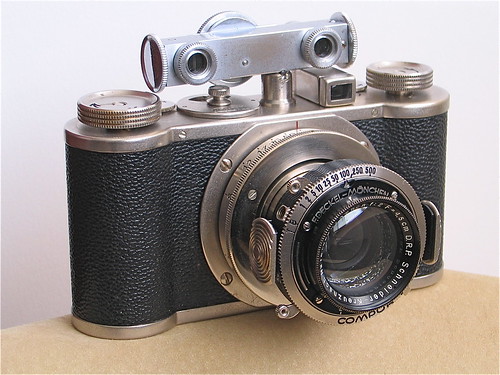
Wirgin Edinex

The Edinex viewfinder cameras for 35mm film were made by Gebr. Wirgin in Wiesbaden. The first model was certainly introduced in the mid-1930s. The same camera was also sold by Adox as the Adrette, released in the late 1930s.
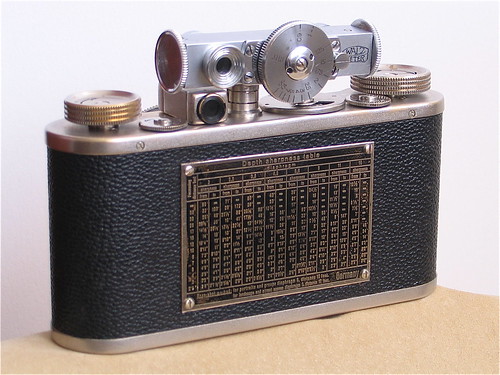
Expensive models of the early Edinex and Adrette were offered with unit focusing and fast lenses, while cheaper models had slower front cell focusing lenses. In both cases, the lens and shutter unit is mounted on a telescopic tube.
Production of the camera was resumed after World War II.
Early Edinex, Schneider Xenon 4.5cm f/2, Compur-Rapid shutter.
A Japanese Walz rangefinder is mounted on the accessory post.
Photo by herrschmidtke @ Flickr
Info: Camera-wiki.org

Friday, February 10, 2012

In-flight Entertainment

Cine projector onboard the ANT-20 Maxim Gorki
The 'flying cinema' was intended for something more serious than passengers' entertainment. Being the propaganda squadron flagship, Maxim Gorky delivered the latest newsreels and (probably) feature films to the periphery.

Read more about the ANT-20 @ Dieselpunks.org

Friday, November 18, 2011

Interchangeable!


French Rex Reflex camera (1949) was the world's first medium-format TLR with interchangeable lenses. Different lens panels were offered, ranging from 59 to 240mm.

Monday, June 6, 2011

Billy-Clack

Agfa medium format (4.5 x 6 cm) camera,
manufactured in Munich
1936

Source: Sylvain Halgand Collection

Sunday, April 10, 2011

Here Come the Reptiles

A rare Foth Folding de Luxe
medium format plate camera, manufactured by C.F.Foth, Berlin
1930

This luxury edition of a popular model boasts special features like crocodile skin-clad body, pure leather bellows, nickel plating and custom paint. An eyecandy.

Tuesday, March 29, 2011

Graflex KE-4 Combat Camera

Manufactured for the military in 1953 these cameras were very large, using 70mm film. Since the design looked like a giant Contax camera it was given the nickname "Gulliver's Contax".

Source: The Camera Heritage Museum

Monday, February 28, 2011

Reporter Camera

The Reporter was a Soviet professional folding medium-format plate camera designed by Ioannisiani brothers and A. Vorozhbit in 1930s.
6.5 x 9 cm frame, F3.5/105 Tessar-type standard lens, focal plane shutter, folding viewfinder, 80-mm rangefinder, filmpack- and roll film adaptors, interchangeable lenses with bayonet mounting.
Between 1939 and 1940, less than 1000 produced.

Source: Popular Mechanics (RU)

Friday, February 18, 2011

Zeiss Ikoflex

This beautiful camera, presented in 1934 and almost instantly nicknamed 'coffeecan', had a special mission: to beat the Rolleiflex, world's first 120-format TLR. In fact, it never doubled Rollei's success.

Thursday, September 9, 2010

Reflex-Korelle

Presented in 1935 by Franz Kochmann Fabrik (Dresden, Germany), this 6 x 6 cm roll film camera paved the way for many medium-format SLR designs. Here's a Korelle I from the first batch.
More photos of the Korelle (1939 model II) and info @ the Tomei Collection

Image: Kameramuseum

Sunday, April 18, 2010

Deco Camera

NiketteWorld's first bakelite rollfilm folding camera
With pop-out strut-supported front,
for 16 pictures 3 x 4 cm on 127 film,
3-element Luxar 3,5/50 lens by F.L. Lucht, Berlin.
Lens shutter 1/25 to 1/100, B, T. With original leather bag.
By C.F.G. Fischer, Berlin
1932

Sunday, March 28, 2010

Deco Kodak

Kodak Beau Brownie camera
Available in five colors from 1930 to 1933
The No.2 measuring 2 ¼" by 3 ¼" and using 120 roll film, and the 2A measuring 2¼" by 4¼", and taking 116 roll film. They originally cost $4 for a No. 2, and $5 for a No. 2A.
Design: Walter Dorwine Teague

Sunday, March 21, 2010