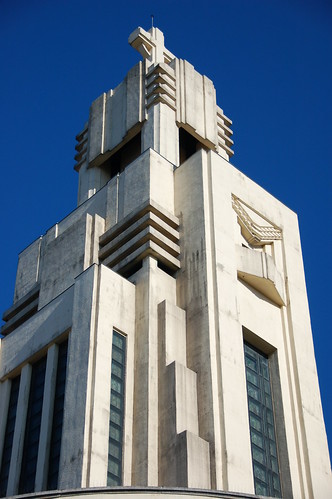
An inscription on the pediment of the pavilion closer to the opening of the first railroad - in 1835,
the first public demonstrations of television in 1935.
The film (in Alberteum), radio-broadcast (the Pavilion of the INR), television, synthesis of these two marvels of modern times, were therefore equally represented in the Exhibition.
The experiments took place in Brussels, before Paris, using apparatus of "Société des Compteurs de Montrouge" (Corporation Counters), patent "Barthélémy", similar appliances those adopted by the P.T.T. minister (Postmaster) equipment for state positions.

Inside the pavilion, the viewfinder was faced with a small screen on which appeared the artist - a singer or musician - who was in the nearby studio: the image was reduced and tinted green. The artist had to smear the face of a special make-up and unflattering, but the image was true and perfectly recognizable. The sound, on the other hand, was not changed the transmission, a shortwave station was installed to do this, inside the Pavilion, by technicians of Radio Schaerbeek.
The principle was: the scene takes place in a glass cage, under fire from eight powerful "spotlights". In a camera, behind a goal similar to that of the camera shooting, an aluminum disk with holes punched in a spiral, spinning at 1,500 revolutions. He strained the light ray and each hit a photodetector, the latter in turn, sent rays at the transmitter, which sent them in waves.
A receiver welcomed them and passed them (for 60 lines, 25 frames, 90,000 "pulses" per second) to a special screen, consisting of a glass coated balloon, at its upper end with a fluorescent substance . The contact with the substance of electrons allowed to reconstruct the image by successive bright spots. The transmitted and presented to the public was about 20 centimeters square ten yards separated the screen artists "televisioned".
If the method in its early days yet called improvements, it nevertheless displays the solution to a problem passionately discussed. And the success of the Palace of the TV was very lively. It just did not attract the attention of crowds. Among other visits, he received those of King Leopold III of Ministers Devèze Van Isacker, Destree; MM. Adolphe Max, Van de Meulebroeck, Count Adrian van der Burch, Caspers, Charles Fonck, M. Laroche, Ambassador of France and members of many scientific associations and others.
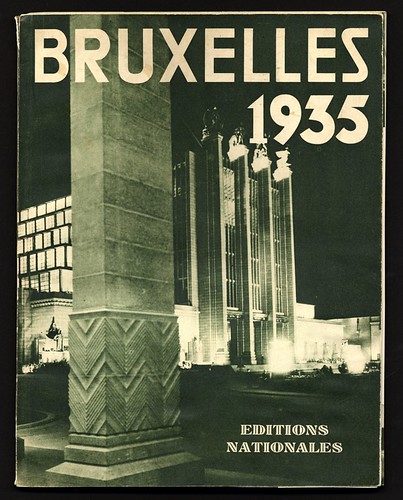
Livre d'Or - Expo 1935


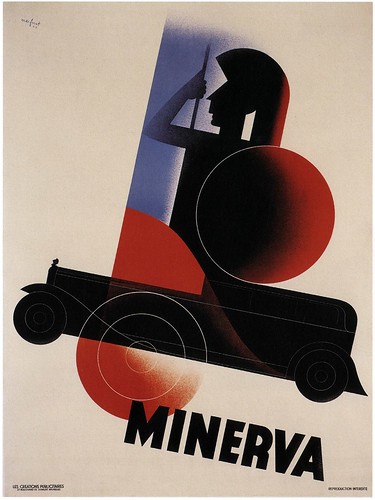
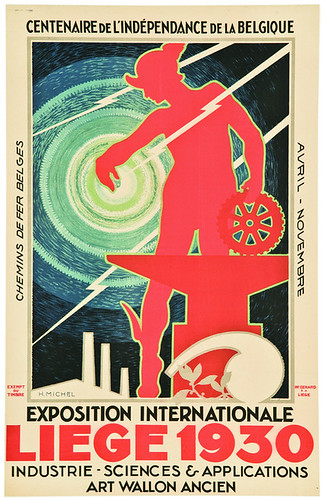 H. Michel poster design for the Belgian International Exposition in Liège, focusing on big industry, sciences and applications, and classic Wallonian art.
 FN Motorcycle poster
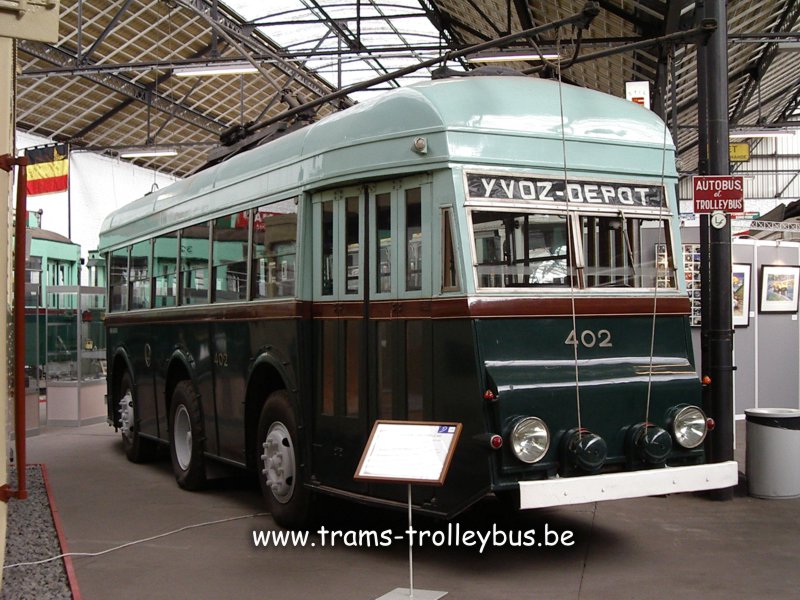
 This 28-seat trolleybus with two driver's positions was build in 1932 for the RELSE (Belgium). It was converted into conventional unidirectional vehicle in 1940 and remained in service untill 1963. Later it was restored into original form - its front and rear are identical.
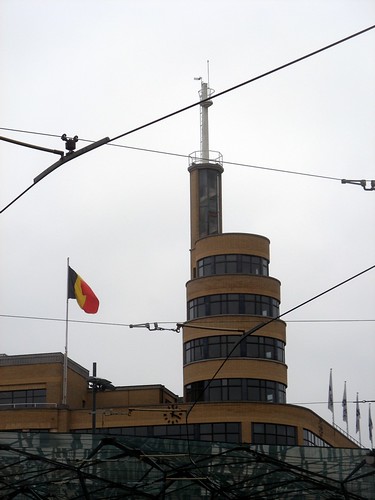 Maison de la Radio
 Belgian aviator with a 0.30 caliber FN38 aircraft machine gun developed by John Browning
 12.004,
 Posts
Posts